
You’re running the microwave while someone makes toast, and the kitchen goes dark. You trudge down to the panel, flip a switch, and everything comes back. Annoying, but you shrug it off. Then it happens again on Thursday. And again next week.
Here’s what I want you to take away from this post: a tripping breaker is not a broken breaker. Nine times out of ten, it’s a safety device doing exactly what it was built to do. The real question is why it’s tripping, because the answer tells you whether this is a “move the toaster” problem or a “call an electrician today” problem.
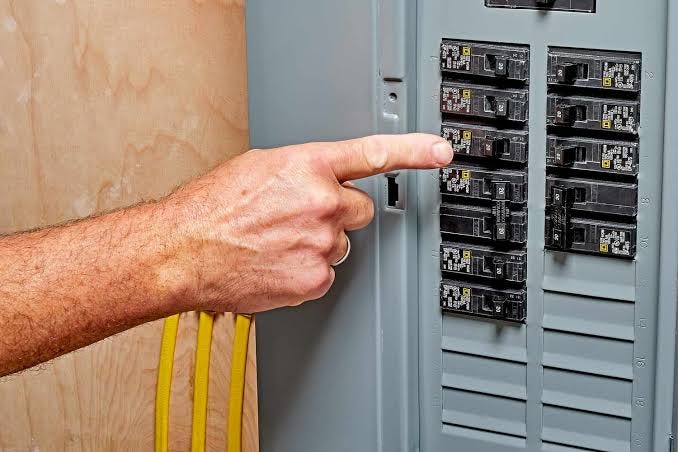
What a breaker is actually doing
Every circuit in your house is wired to carry a limited amount of electricity safely, usually 15 or 20 amps for regular outlets and lights. The breaker is the guard at the door. If more current flows than the wires can handle, it cuts power before the wires overheat. That’s the whole job.
There are three reasons a breaker trips, and they’re very different in how serious they are.
Thanks for reading Homeowner Help! Subscribe for free to receive new posts and support my work.
Reason 1: Overload (the common, mostly harmless one)
Too many things are pulling power on one circuit at once. Classic culprits are the kitchen (microwave, toaster, coffee maker, air fryer), space heaters, hair dryers, and window AC units.
How to recognize it:
- It trips only when certain appliances run together
- It trips after the load has been on for a minute or so, not instantly
- Everything works fine again after you reset it, until you repeat the combo
The fix: spread the load. Plug the high-draw appliances into outlets on different circuits (try the other side of the kitchen, or a different room). Space heaters especially should have an outlet to themselves, since they pull close to the entire capacity of a 15-amp circuit all by themselves.
Reason 2: Short circuit (take this one seriously)
A hot wire is touching a neutral or ground wire, which causes a sudden surge of current. This happens with damaged cords, loose or frayed wiring, or a failing appliance.
How to recognize it:
- The breaker trips instantly, often with a loud pop or click
- You may notice a burning smell, scorch marks, or a warm or discolored outlet or plug
- It trips again right away when you reset it
What to do: unplug everything on that circuit, then reset the breaker. If it holds, plug devices back in one at a time. The one that trips it is your culprit, so throw out that cord or appliance. If the breaker trips with nothing plugged in, the problem is in the wiring itself. Leave it off and call an electrician.
Reason 3: Ground fault (the bathroom, kitchen, and outdoor one)
Electricity is taking an unintended path, often through moisture. This is what GFCI outlets and breakers are designed to catch, and they’re deliberately sensitive because water plus electricity is dangerous.
How to recognize it:
- It’s an outlet in a bathroom, kitchen, garage, basement, or outdoors
- The outlet has “TEST” and “RESET” buttons in the middle
- It tripped after rain, after a splash, or when using a damp tool or appliance
The free fix people don’t know about: if an outlet is dead and nothing seems tripped at the panel, look for a GFCI outlet somewhere else nearby and press its RESET button. One GFCI often protects several outlets downstream, including ones in other rooms. Garage and bathroom GFCIs killing the power to an outdoor outlet is probably the most common “my outlet is broken” call that isn’t a broken outlet at all.
If a GFCI trips repeatedly with nothing obviously wet, the device itself may be worn out (they last roughly 10 to 15 years). Replacement units run around $15 to $25, but if you’re not comfortable working with wiring, this is a fine one to hand off.
Quick troubleshooting order
- Note what was running when it tripped.
- Unplug everything on that circuit.
- Reset the breaker by pushing it fully to OFF first, then back to ON. A tripped breaker often sits in a middle position, and pushing straight to ON doesn’t always work.
- Plug items back in one at a time and see what trips it.
- Spread the load if it’s an overload, or replace the culprit if it’s one bad appliance.
Please don’t do these
- Don’t swap in a bigger breaker to stop the tripping. The wire in the wall is sized for the breaker. A bigger breaker lets the wire overheat before it trips, which is how house fires start.
- Don’t tape or hold a breaker in the ON position. Same reason.
- Don’t take the panel cover off. The wires inside the main panel stay live even when the main breaker is off. Resetting breakers on the outside is fine, but anything inside the box belongs to an electrician.
- Don’t ignore the warning signs: a burning smell, a hot or buzzing outlet or breaker, flickering lights alongside the tripping, or scorch marks. Those mean stop using that circuit and call a licensed electrician.
Call a pro if…
- A breaker trips with nothing plugged in
- You smell burning or see discoloration anywhere near an outlet or the panel
- The same breaker trips over and over even after you’ve reduced the load
- Your home is older and you have a lot of tripping across multiple circuits, which can mean the wiring or panel is undersized for how you live now
Before you go
Most of the time this is a $0 fix: move the space heater to a different outlet and you’re done. But now you know how to tell the difference between a breaker that’s annoyed and one that’s trying to save your house.
Next up: the sink that drains slowly, and why Drano is usually the wrong first move.
Talk soon, AJ


Leave a Reply